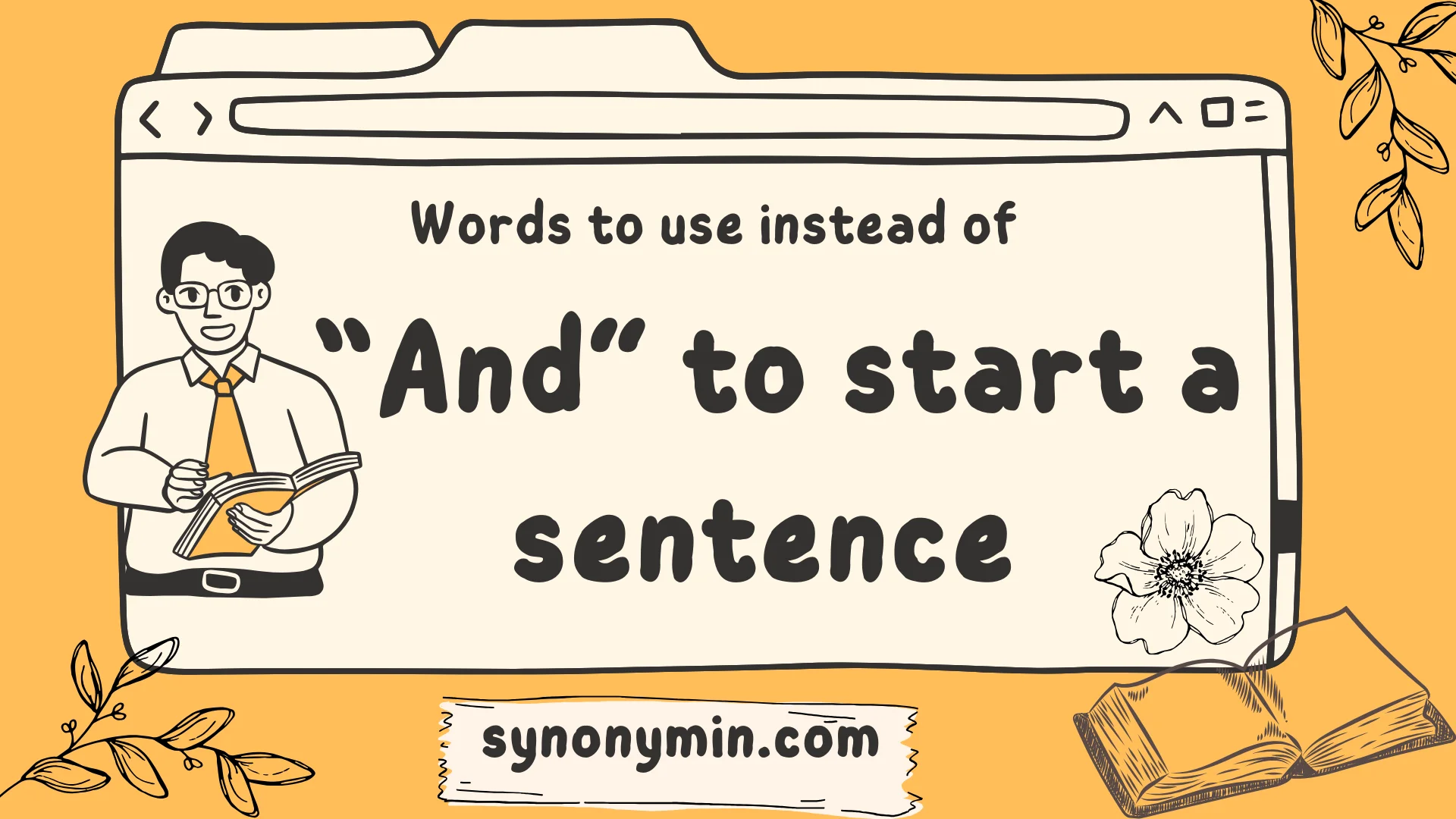
Starting too many sentences with “And” can make your writing feel repetitive, informal, or choppy — especially in professional or academic contexts. While “And” is grammatically acceptable at the beginning of a sentence, strong writers often choose more polished alternatives to create smoother transitions and clearer flow.
This guide gives you 40+ professional, modern, and natural alternatives you can use instead of “And” — with examples, usage notes, and explanations to help you choose the right one every time.
📌 When Should You Use These Alternatives?
Use these alternatives when you want to:
- Make your writing sound more formal or polished
- Create stronger transitions between ideas
- Avoid repetition in emails, reports, essays, or articles
- Show cause, contrast, sequence, or emphasis more clearly
Each phrase serves a specific purpose — choose based on the meaning you want to express.
📝 Professional Alternatives to “And” to Start a Sentence
Below are 40+ refined, context-appropriate options. Each includes the phrase, meaning, examples, and why it works.
1. Additionally
Meaning: Adds new information smoothly.
Example: Additionally, we have updated the project timeline.
Why it works: A clean, professional transition used widely in business writing.
2. Furthermore
Meaning: Adds supporting information with emphasis.
Example: Furthermore, the results exceeded our expectations.
Why it works: Strong, formal, and ideal for reports and presentations.
3. Moreover
Meaning: Adds information that strengthens the previous point.
Example: Moreover, this strategy reduces long-term costs.
Why it works: Useful for persuasive or analytical writing.
4. In addition
Meaning: Introduces another relevant point.
Example: In addition, the software offers advanced security features.
Why it works: Simple and universally appropriate.
5. Also
Meaning: A lightweight connector for extra information.
Example: Also, we plan to launch the update next week.
Why it works: Friendly, conversational, and easy to read.
6. What’s more
Meaning: Adds a noteworthy or impressive point.
Example: What’s more, the new design cuts loading time in half.
Why it works: Engaging and persuasive.
7. Besides
Meaning: Adds supporting or complementary information.
Example: Besides, we already completed the necessary approvals.
Why it works: Useful when emphasizing that something is not the only point.
8. As well
Meaning: Soft addition to a previous point.
Example: As well, the team will begin training next week.
Why it works: Casual but still professional when used correctly.
9. Likewise
Meaning: Shows similarity or alignment.
Example: Likewise, the marketing team has updated its strategy.
Why it works: Smooth parallel transition.
10. Similarly
Meaning: Introduces a point that mirrors another.
Example: Similarly, our competitors are adopting this approach.
Why it works: Excellent for comparisons.
11. In the same way
Meaning: Draws a parallel between two ideas.
Example: In the same way, our department will restructure its workflow.
Why it works: Helps reinforce logical connections.
12. On top of that
Meaning: Adds emphatic additional information.
Example: On top of that, customer satisfaction has improved.
Why it works: Stronger and more engaging than “and.”
13. Coupled with this
Meaning: Combines multiple supporting factors.
Example: Coupled with this, we saw increased engagement.
Why it works: Perfect for analytical writing.
14. Plus
Meaning: Light, conversational addition.
Example: Plus, the tool is free for all team members.
Why it works: Clear and approachable.
15. Apart from that
Meaning: Adds another piece of information not previously mentioned.
Example: Apart from that, everything is ready for launch.
Why it works: Good for updates and reporting.
16. Not to mention
Meaning: Adds a point of emphasis or importance.
Example: Not to mention, it saves us significant time.
Why it works: Engaging and impactful.
17. Equally important
Meaning: Highlights a point of equal significance.
Example: Equally important, we must maintain compliance.
Why it works: Shows balance in your reasoning.
18. Correspondingly
Meaning: Shows correlation between two actions or facts.
Example: Correspondingly, team productivity increased.
Why it works: Great for data-driven writing.
19. As a result
Meaning: Shows consequence or outcome.
Example: As a result, we exceeded our quarterly goals.
Why it works: Makes cause-and-effect clear.
20. Consequently
Meaning: Strong formal indicator of result.
Example: Consequently, the project was delayed.
Why it works: Perfect for academic and analytical writing.
21. Therefore
Meaning: Indicates logical conclusion.
Example: Therefore, we recommend moving forward with the plan.
Why it works: Crisp, clear, authoritative.
22. Thus
Meaning: Indicates reasoning or outcome concisely.
Example: Thus, we adjusted the pricing model.
Why it works: Ideal for formal writing.
23. Hence
Meaning: A concise indicator of result or implication.
Example: Hence, additional training is required.
Why it works: Works well in analytical or technical writing.
24. As well as that
Meaning: Adds supportive information.
Example: As well as that, we will include user feedback in the next release.
Why it works: Smooth and flexible.
25. To add to that
Meaning: Introduces an extra supportive point.
Example: To add to that, our customer retention rate has increased.
Why it works: Conversational and easy to understand.
26. In fact
Meaning: Emphasizes or reinforces a point.
Example: In fact, this update makes the system twice as fast.
Why it works: Strong emphasis, highly engaging.
27. To top it off
Meaning: Adds a final impressive point.
Example: To top it off, we completed the project ahead of schedule.
Why it works: Great for persuasive writing.
28. Beyond that
Meaning: Adds information beyond what was previously discussed.
Example: Beyond that, no additional changes are required.
Why it works: Smooth and modern transition.
29. In other words
Meaning: Clarifies or restates.
Example: In other words, we’re ready to launch.
Why it works: Perfect for explanations.
30. To summarize
Meaning: Begins a concise recap.
Example: To summarize, all objectives have been achieved.
Why it works: Excellent for conclusions or summaries.
31. To illustrate
Meaning: Introduces an example.
Example: To illustrate, our response time improved by 40%.
Why it works: Ideal for reports or teaching.
32. In short
Meaning: Provides a brief summary.
Example: In short, the project was a success.
Why it works: Clear and impactful.
33. In conclusion
Meaning: Leads into a final point.
Example: In conclusion, the strategy has proven effective.
Why it works: Classic formal ending.
34. Meanwhile
Meaning: Indicates parallel action.
Example: Meanwhile, the design team completed the prototypes.
Why it works: Great for timeline context.
35. At the same time
Meaning: Shows simultaneous events or considerations.
Example: At the same time, we must ensure quality standards.
Why it works: Enhances clarity in complex writing.
36. Even so
Meaning: Shows contrast.
Example: Even so, we managed to finish on time.
Why it works: Effective for nuanced transitions.
37. Still
Meaning: Introduces a slight contradiction.
Example: Still, more testing is required.
Why it works: Short, sharp, and powerful.
38. However
Meaning: Strong contrastive transition.
Example: However, the final decision remains pending.
Why it works: One of the most reliable formal alternatives.
39. On the other hand
Meaning: Introduces an opposing perspective.
Example: On the other hand, this option may increase costs.
Why it works: Perfect for balanced arguments.
40. Conversely
Meaning: Indicates the opposite case.
Example: Conversely, automation reduces manual workload.
Why it works: Ideal for analytical and technical writing.
⚡ Quick One-Line Templates
- Additionally, here are the updated details.
- Furthermore, we have identified new opportunities.
- Moreover, this approach will improve efficiency.
- In addition, please review the attached file.
- On top of that, the results are highly positive.
- Consequently, we adjusted the timeline.
- However, we still need final approval.
- In short, everything is ready for launch.
⚠️ Common Mistakes to Avoid
Avoid these when replacing “And”:
- ❌ Overusing the same transition repeatedly
- ❌ Choosing a phrase that doesn’t match the meaning
- ❌ Using overly formal transitions in casual emails
- ❌ Starting too many sentences with connectors
- ❌ Mixing contradictory transitions (“However” vs. “Additionally”)
Use alternatives purposefully, not randomly.
❓ FAQ
1. Is it wrong to start a sentence with “And”?
No — it’s grammatically acceptable. But excessive use reduces clarity and professionalism.
2. What’s the best alternative for formal writing?
Additionally, Moreover, Furthermore, Therefore, and However work best.
3. What should I use in emails?
Try Also, In addition, Plus, On top of that, Meanwhile.
4. Which alternatives work for essays?
Furthermore, Moreover, Consequently, Conversely, Similarly are ideal.
5. Are these alternatives SEO-friendly?
Yes — varied transitions improve readability and ranking signals.
6. Can I use more than one alternative in a paragraph?
Yes, as long as each transition fits the meaning.
🏁 Conclusion
Using “And” at the start of a sentence isn’t wrong — but powerful writers know how to vary their transitions for clarity, flow, and professionalism. With these 40+ polished alternatives, you can elevate your writing whether you’re drafting an email, essay, report, or article.
Choose your transitions intentionally, match them to your meaning, and your writing will instantly feel more modern, confident, and refined.
DISCOVER MORE ARTICLES
Can You Start a Sentence With “Even Though”? (Complete Guide + 30 Alternatives)
Synonyms for “To Do So”: 35+ Professional Alternatives (With Examples)
Formal Synonyms for “Speed Up the Process” (40+ Professional Alternatives)