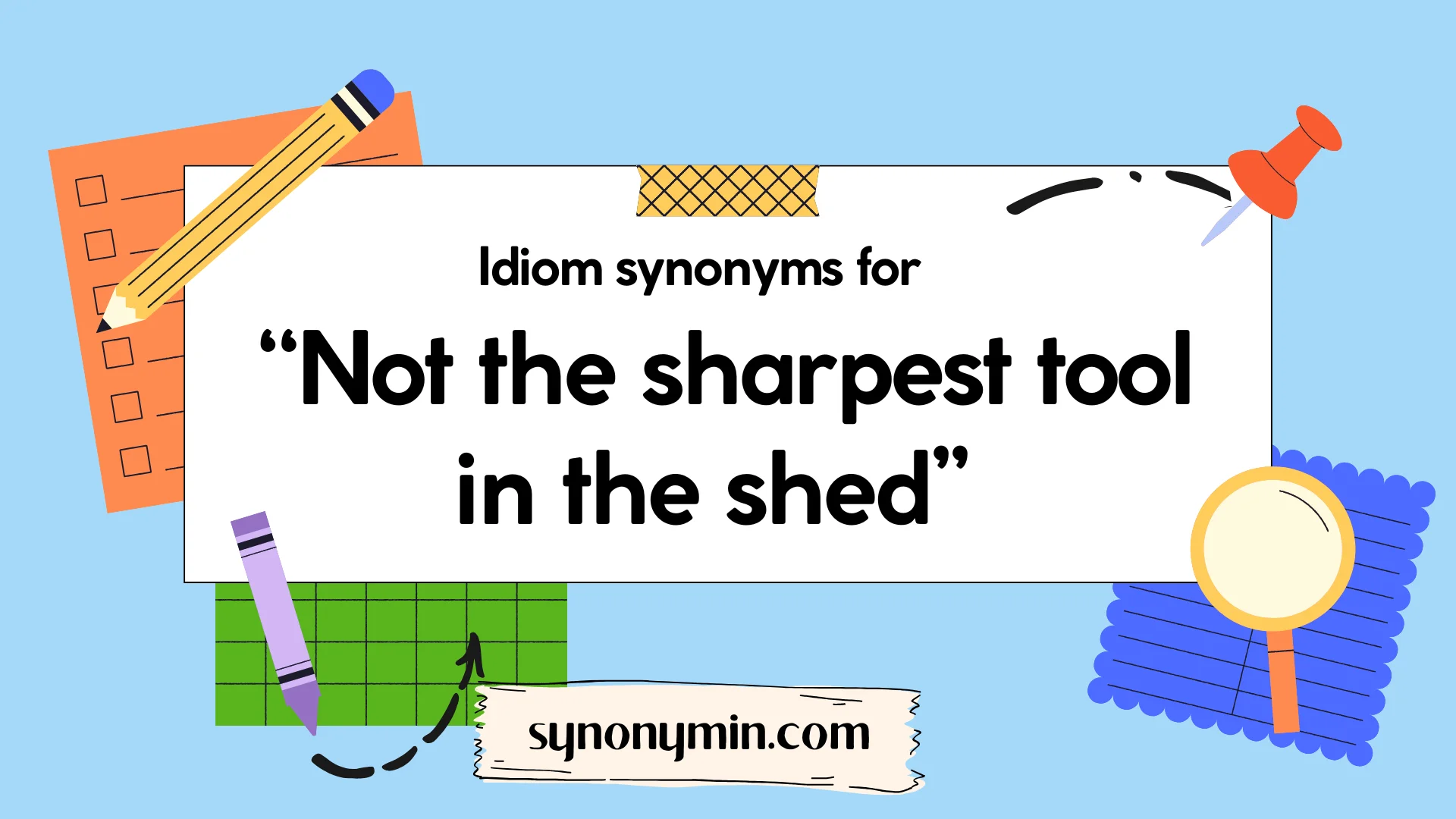
When describing someone who may be a little slow to understand things, we often use the idiom “not the sharpest tool in the shed.” But in professional, educational, or polished writing, this phrase can sound harsh, informal, or even insulting.
A more tactful approach is to use refined, nuanced, and context-appropriate alternatives that soften the tone while preserving the meaning.
This guide gives you modern, respectful, and effective idiom-based synonyms, complete with examples and usage notes—so you can communicate clearly without sounding rude.
📝 When Should You Use These Alternatives?
Use alternative idioms when you want to:
- communicate diplomatically about someone’s misunderstanding
- avoid sounding insulting or unprofessional
- maintain a polished tone in writing or speech
- keep feedback kind yet honest
- express the idea in a creative or humorous way without offending
These alternatives are ideal for workplaces, teaching contexts, performance reviews, or polite conversation.
🧩 35+ Idiom-Based Synonyms (Meaning+ Examples)
Below are professional, tactful alternatives. Each includes meaning, an example, and why it works.
1. “A bit slow on the uptake”
Meaning: Takes a little longer to understand things.
Example: He’s a bit slow on the uptake, so we may need to explain it again.
Why it works: Softer and less insulting while still clear.
2. “Not the quickest to grasp things”
Meaning: Learns or understands at a slower pace.
Example: She’s not the quickest to grasp things, but she improves with guidance.
Why it works: Professional and diplomatic.
3. “A little behind the curve”
Meaning: Not up to the same level of understanding as others.
Example: He’s a little behind the curve with the new system.
Why it works: Sounds analytical, not judgmental.
4. “A bit out of his depth”
Meaning: Struggling because the task is too complex.
Example: He seemed a bit out of his depth during the discussion.
Why it works: Focuses on the situation, not the person.
5. “Not firing on all cylinders”
Meaning: Not performing at full ability.
Example: The team wasn’t firing on all cylinders this morning.
Why it works: Friendly, humorous, and non-offensive.
6. “A few steps behind”
Meaning: Slightly slower than others in comprehension.
Example: She’s a few steps behind on the new protocol.
Why it works: Neutral and non-personal.
7. “Needs a bit more time to process things”
Meaning: Requires longer to understand information.
Example: He needs a bit more time to process things during training.
Why it works: Empathetic and polite.
8. “Not the fastest learner”
Meaning: Learns at a slower pace.
Example: She’s not the fastest learner, but she’s thorough.
Why it works: Honest but balanced.
9. “A little slow to catch on”
Meaning: Takes time to understand new information.
Example: He’s a little slow to catch on with tech updates.
Why it works: Common, clear, not rude.
10. “Still getting the hang of it”
Meaning: Has not yet fully learned something.
Example: She’s still getting the hang of the new software.
Why it works: Encouraging and positive.
11. “Not quite connecting the dots yet”
Meaning: Hasn’t fully understood how things relate.
Example: He’s not quite connecting the dots yet on the project goals.
Why it works: Focuses on understanding, not intelligence.
12. “Takes a little extra explanation”
Meaning: Needs more clarity or repetition.
Example: This topic takes a little extra explanation for her.
Why it works: Gentle and respectful.
13. “A bit slow off the mark”
Meaning: Slow to respond or understand.
Example: He was a bit slow off the mark during the meeting.
Why it works: Neutral and idiomatic.
14. “Not exactly a quick study”
Meaning: Learns slowly.
Example: He’s not exactly a quick study, but he’s dependable.
Why it works: Balanced and polite.
15. “Still warming up to the concept”
Meaning: Needs time to fully understand.
Example: She’s still warming up to the concept of automation.
Why it works: Encouraging and supportive.
16. “A bit literal-minded”
Meaning: Struggles with abstract ideas.
Example: He’s a bit literal-minded, so metaphors can confuse him.
Why it works: Specific and tactful.
17. “Not the quickest thinker in the room”
Meaning: Others think faster.
Example: He’s not the quickest thinker in the room, but he’s reliable.
Why it works: Honest yet softens the comparison.
18. “Still piecing things together”
Meaning: Hasn’t fully understood yet.
Example: She’s still piecing things together after the training session.
Why it works: Conveys progress, not failure.
19. “A bit absent-minded”
Meaning: Often forgetful or distracted.
Example: He can be a bit absent-minded during tasks.
Why it works: Focuses on behavior rather than intelligence.
20. “Needs clearer guidance”
Meaning: Struggles without detailed instructions.
Example: He needs clearer guidance on the new workflow.
Why it works: Practical and professional.
21. “A bit forgetful at times”
Meaning: Doesn’t remember instructions easily.
Example: She can be a bit forgetful at times with deadlines.
Why it works: Gentle and empathetic.
22. “Still learning the ropes”
Meaning: New or inexperienced.
Example: He’s still learning the ropes in this role.
Why it works: Positive and forgiving.
23. “Not the most detail-oriented”
Meaning: Misses small but important points.
Example: She’s not the most detail-oriented, but she handles big-picture tasks well.
Why it works: Honest but fair.
24. “A little scatterbrained”
Meaning: Disorganized, easily distracted.
Example: He can be a little scatterbrained during onboarding.
Why it works: Casual and lighthearted.
25. “Needs extra support to understand complex ideas”
Meaning: Has difficulty with complicated information.
Example: She needs extra support to understand complex ideas.
Why it works: Professional and compassionate.
26. “Not quite up to speed yet”
Meaning: Behind in understanding or progress.
Example: He’s not quite up to speed yet on the new process.
Why it works: Neutral and progress-based.
27. “A bit slow-paced in thinking”
Meaning: Processes information slowly.
Example: She’s a bit slow-paced in thinking, especially under pressure.
Why it works: Soft and descriptive.
28. “Has a learning curve to overcome”
Meaning: Needs time to adjust or master tasks.
Example: He has a learning curve to overcome with digital tools.
Why it works: Normalizes difficulties.
29. “A little rusty in certain areas”
Meaning: Out of practice.
Example: She’s a little rusty in data analysis.
Why it works: Blames lack of practice, not ability.
30. “Still adapting to the pace”
Meaning: Struggling to keep up.
Example: He’s still adapting to the pace of the new department.
Why it works: Professional and kind.
31. “Needs concepts broken down more clearly”
Meaning: Needs step-by-step explanation.
Example: She needs concepts broken down more clearly during meetings.
Why it works: Puts responsibility on communication, not intelligence.
32. “Not always quick with problem-solving”
Meaning: Slow at figuring things out.
Example: He’s not always quick with problem-solving, but he’s diligent.
Why it works: Honest but non-judgmental.
33. “A bit slow to respond”
Meaning: Takes time to react or understand.
Example: He’s a bit slow to respond during brainstorming.
Why it works: Polite and commonly used.
34. “Needs extra clarification”
Meaning: Requires repeated or simplified explanations.
Example: She needs extra clarification on the task requirements.
Why it works: Neutral and constructive.
35. “Still building confidence with complex tasks”
Meaning: Hesitant or unsure with advanced work.
Example: He’s still building confidence with complex tasks.
Why it works: Encouraging and supportive.
⚡ Quick One-Line Templates
- “He’s still getting up to speed with the new process.”
- “She needs a bit more time to grasp the concept.”
- “He’s still piecing everything together.”
- “She may need clearer guidance on this task.”
- “He’s a bit slow on the uptake with technical information.”
- “She’s still learning the ropes, so patience is key.”
🚫 Common Mistakes to Avoid
- ❌ Using harsh or insulting phrases (unprofessional and disrespectful)
- ❌ Overusing idioms that sound sarcastic
- ❌ Applying these phrases in sensitive or formal evaluations
- ❌ Making comments personal instead of task-focused
- ❌ Using humor when the situation requires seriousness
Always prioritize tact, clarity, and professionalism.
❓ FAQ
1. Are these alternatives polite enough for workplace use?
Yes—these idioms are designed to sound tactful, diplomatic, and professional.
2. Which option is best for performance reviews?
Choose neutral ones like “still learning the ropes” or “needs extra clarification.”
3. Are humorous idioms acceptable?
Yes, but only in relaxed settings and with people who won’t misinterpret them.
4. Can these idioms be used formally?
Some can (e.g., “not up to speed”), but avoid informal ones like “scatterbrained.”
5. Are these phrases insulting?
Not if used carefully—they are intentionally softer versions of a harsh idiom.
🎯 Conclusion
Using thoughtful alternatives to “not the sharpest tool in the shed” helps you maintain professionalism, respect, and emotional intelligence in communication. These idiom-based phrases allow you to convey the same idea—but with diplomacy, finesse, and clarity.
With this list, you can choose expressions that fit your tone, audience, and situation—ensuring your message remains polished, tactful, and effective.
DISCOVER MORE ARTICLES
Best Professional Alternatives to “First of Its Kind” (40+ Options)
Professional Synonyms for “For More Information”: 30+ Powerful Alternatives
Different Ways to Say “I’m Praying for You” (With Examples & Meanings)